Last issue, we took a look at some of the money that the government owes you and how to claim it, but in this issue, we’re flipping it! This is money that YOU’RE LOSING every month, to things you forgot you signed up for in the first place.
The issue isn’t the $6 latte that you enjoy. It’s the $6 charges you don’t even remember agreeing to.
You’ve heard the other version of this a hundred times. “Skip the coffee, brew it at home, and someday you’ll be rich.” That advice is so old, and it’s honestly a little insulting. We’re living in a new era where the coffee you actually enjoy isn’t the problem, it’s the free trial you forgot to cancel, the app you used twice in March, the “premium” tier you meant to downgrade. That’s the stuff worth hunting down.
Why you underestimate your subscriptions
Ask yourself how many things you pay for every month. Whatever number popped into your head, is probably too low.
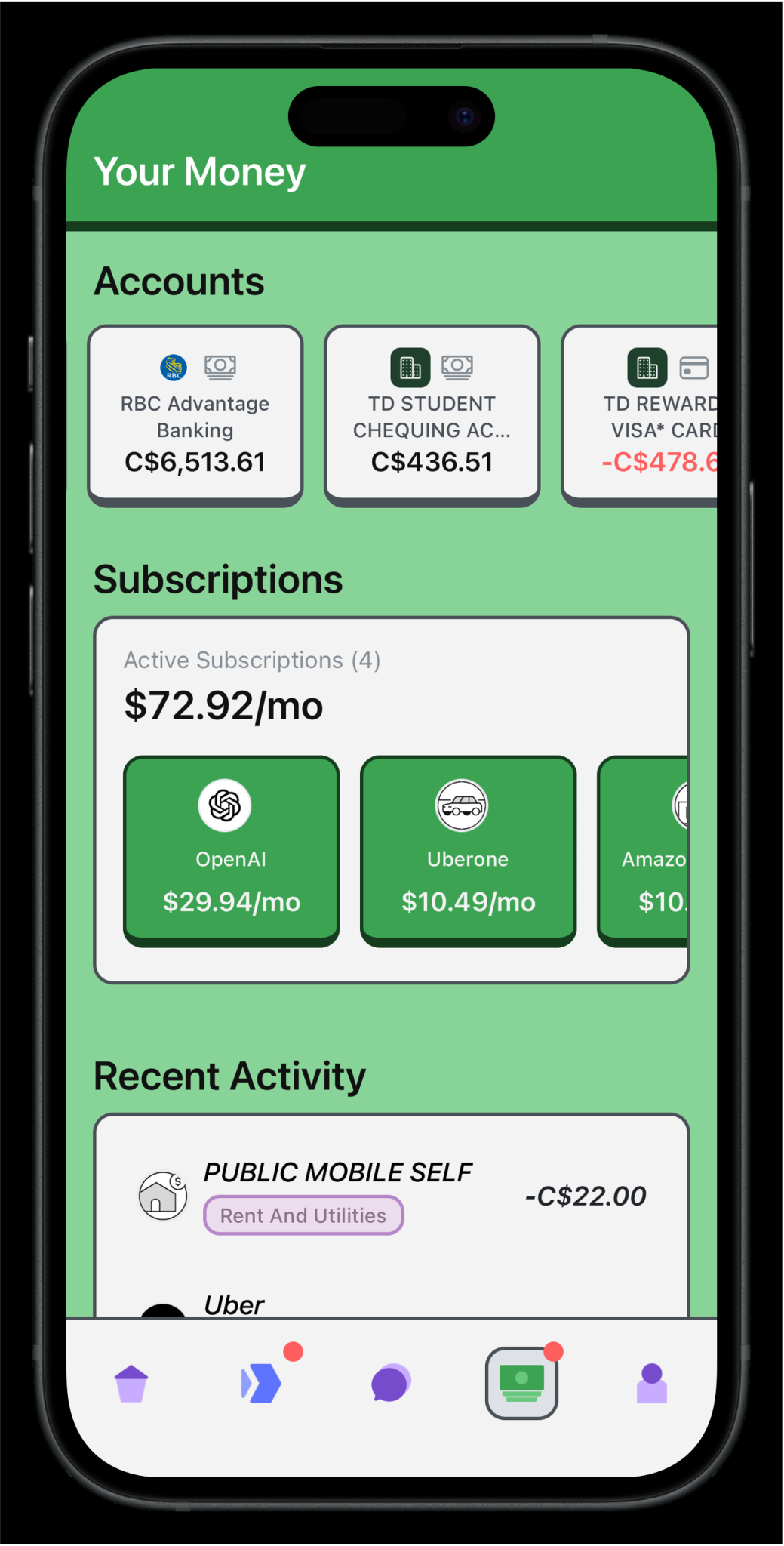
A 2024 Hardbacon survey found that Canadians have, on average, eight recurring subscriptions, while thinking that they only have four. Half of what you’re paying for isn’t even in your mental picture of your own spending. And these aren’t rounding errors: 66% of people surveyed had been billed for a subscription they’d forgotten about.
A recurring subscription is any charge that renews on its own until you stop it: streaming, cloud storage, a fitness app, a game pass, the “pro” version of something you use for free. A one-time $60 purchase makes you stop and decide, but a $9.99 that renews every month quietly never asks you again.
This is the same trap we covered in Issue 8: your balance looks like spending money, but a chunk of it is already committed to charges that haven’t left yet. Subscriptions are the sneakiest version of that committed money, because you can’t picture all of them at once.
The banking fees
If you’re a full-time student paying a monthly fee for your chequing account, there’s a decent chance you’re paying it for no reason.
A monthly account fee is what a bank charges you for keeping a chequing account open, separate from anything you buy or transfer. For a regular adult account it runs somewhere around $13 to $17 a month (RBC’s Advantage account is $12.95, CIBC’s Smart account is $16.95). Every one of the big banks waives that fee for full-time students, so paying it while you’re enrolled is money going out the door for no reason.
Here’s what the four we checked offer, as of July 8, 2026:
| Bank | Student account | Monthly fee | The catch |
|---|---|---|---|
| RBC | Advantage Banking for students | $0 | Full-time student and/or age 24 and under; they may ask for proof of enrolment |
| TD | Student Chequing Account | $0 | No fee until age 23; after that you need proof of full-time enrolment |
| Scotiabank | Student Banking Advantage Plan | $0 | Must be enrolled full-time; proof required; it converts once your student status expires |
| CIBC | Smart for Students | $0 | Full-time students; stays fee-free through graduation plus six months |
The pattern is the same everywhere: $0 while you’re a full-time student, and you may need to show proof of enrolment to switch on the waiver or keep it. If your account is on a paid plan right now, the fix is one message to your bank asking to move to the student version.
Bounced-payment fees just got a lot smaller
Here’s some good news you might have missed. As of March 12, 2026, the fee your bank can charge you for a bounced payment is capped at $10.
First, the term. An NSF fee (“non-sufficient funds”) is what your bank charges when a payment tries to come out and there isn’t enough in your account to cover it, so the payment bounces. It’s worth keeping this separate from overdraft protection, which is the opposite outcome: an NSF fee hits when a payment bounces because you had no overdraft protection, while overdraft protection lets the payment go through for a separate fee. One means the payment failed. The other means it went through and you’ll pay a charge for the privilege.
The NSF fee used to be brutal for what it was. At the six largest banks it typically ran $45 to $48 for a single bounced payment. New federal rules under the Bank Act now cap it at no more than $10.
A quick example (illustration only, your numbers will vary). Say your phone bill comes out as a pre-authorized payment and your account is short that day, so it bounces. Before March 2026, that one bounce would have cost you somewhere around $45 to $48. Under the new cap, the most your bank can charge for the same bounce is $10.
The rules come with a few more protections worth knowing:
- No more than one NSF fee every two business days, so a run of bounces on the same tight week can’t stack up endlessly.
- No fee at all when the shortfall is under $10, so a payment that misses by pocket change won’t cost you anything.
- The cap applies to personal and joint accounts, not business accounts.
One important limit: this cap covers federally regulated banks only. Provincial credit unions are regulated by the provinces, so they aren’t covered by this rule. More on that in the questions below.
The 15-minute statement audit
This is the payoff, and it’s the whole point of this week’s edition. You don’t need an app, a spreadsheet, or a budgeting system to do it. You need last month’s bank statement and about fifteen minutes. (If you want to turn this into an ongoing habit afterward, our guide on budgeting on a student income covers the tracking side.)
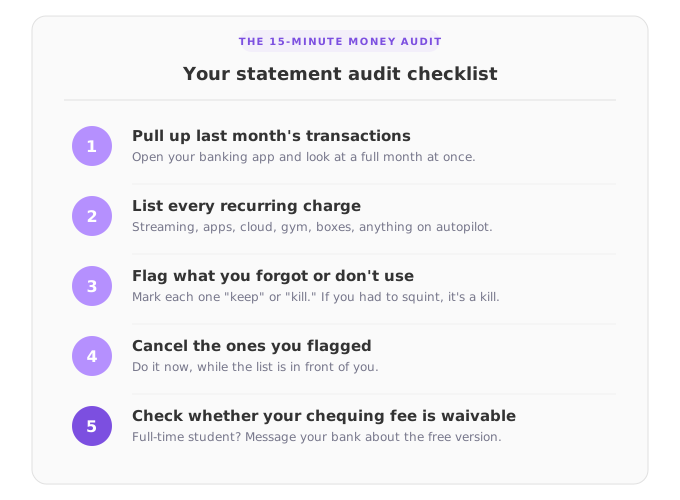
Step 1: Pull up last month’s transactions
Open your banking app or log in and look at a full month of transactions. One month is enough to catch almost everything that renews monthly. If you can, do it on a laptop rather than your phone, so you can see more at once.
Step 2: List every recurring charge
Go top to bottom and write down anything that repeats or looks like it will. Streaming, music, cloud storage, apps, gym, subscription boxes, that one thing you can’t quite place. Include the ones you pay yearly if they happen to show up. The goal is a single list of everything charging you on autopilot.
Step 3: Flag what you forgot or don’t use
Beside each one, mark it “keep” or “kill.” Keep is for the things you actually use and enjoy. Kill is for the free trial that turned into a paid plan, the app you opened twice, the tier you meant to downgrade months ago. If you had to squint to remember what it even was, that’s a kill.
Step 4: Cancel the kills
Cancel them now, while the list is in front of you, before you talk yourself out of it. Most cancellations take under a minute from the account settings. The ones that hide the cancel button are exactly the ones worth the extra thirty seconds to find it.
Step 5: Check whether your chequing fee is waivable
While you’re in there, check whether you’re paying a monthly account fee. If you’re a full-time student and you’re paying one, message your bank about moving to the student version from the table above. That’s one more recurring charge gone.
That’s the whole audit. The money you free up here isn’t a someday-you’ll-be-rich promise. It’s real dollars that were leaving your account this month and now aren’t. If you want somewhere useful to point that freed-up money, Issue 11 covers high-interest savings accounts and where short-term money is best parked.
Common questions
Isn’t cancelling subscriptions just the “skip the latte” thing again? No, and the difference is the whole point. The latte advice tells you to give up something you use and enjoy for a small daily saving. This is the opposite. You keep everything you actually use, the coffee included. You cancel only the things you forgot you were paying for and get nothing from. One asks you to feel guilty about a purchase you made on purpose. The other asks you to stop paying for purchases you’re not even making anymore.
Will cancelling anything hurt me? Cancelling a subscription stops future charges. It doesn’t touch your credit, your bank account standing, or anything else. The worst case is you miss something and re-subscribe, which takes about a minute. That’s a much smaller risk than paying for a year of something you never open.
What if I share a subscription with roommates or family? Then it belongs in the “keep” column, as long as it’s genuinely being used and the cost is split fairly. The audit isn’t about cutting everything. A shared plan that four people use is doing its job. Just make sure the person whose card it’s on is actually getting paid back.
Does the $10 NSF cap cover credit unions? No. The cap applies to federally regulated banks only. Credit unions are regulated by the provinces, not the federal government, so this rule doesn’t reach them. If you bank with a credit union, check its own fee schedule for what it charges on a bounced payment, and don’t assume the $10 cap applies.
This Week’s Recommendations
Read: The Year of Less by Cait Flanders. A Canadian writer’s account of a yearlong ban on buying anything but essentials, and what she learned about the stuff she was paying for on autopilot. Honest about how much of it she didn’t miss.
Listen: Mostly Money by Preet Banerjee. A Canadian host who breaks down the everyday money decisions school skips, in plain language, without the jargon that makes most finance shows a slog.