We’ve spent a few issues talking about accounts: TFSAs, RRSPs, FHSAs, how they work, why they matter. But an account is a container. Opening a TFSA and leaving cash in it is like buying a gym membership and sitting in the parking lot. The account gives you the tax advantage. You still have to decide what goes inside it.
This issue is about what to do with the money once it’s in the account.
Three main options: a high-interest savings account, ETFs, or a robo-advisor. Each one works differently, costs differently, and suits a different situation. The right choice depends on when you need the money.
Option 1: High-Interest Savings Account (HISA)
A HISA pays you interest on your balance, calculated daily and deposited monthly. Your principal doesn’t move with the market. You put in $1,000, it stays $1,000 (plus whatever interest it earns). That’s the appeal.
Online banks tend to offer rates in the 1.50%–3.00%+ range, while big banks often sit below 1% unless they’re running a promotional rate. The gap is significant over time, so it’s worth shopping around.
You can hold a HISA inside a TFSA or FHSA. Interest earned inside a registered account is tax-free. Outside a registered account, you report the interest as income on your tax return.
A few things worth knowing:
- Your money is protected. CDIC insures deposits up to $100,000 per category (personal, TFSA, FHSA, etc.) at member institutions. Each category gets its own $100,000 of coverage. Alberta credit unions have separate coverage through the CUDGC, which guarantees 100% of deposits with no dollar limit.
- No fees at most online banks. Most online HISAs have no monthly fees and no minimum balance. Some big-bank HISAs charge per-transaction fees or require a minimum balance to earn interest.
- Full liquidity. You can withdraw at any time with no penalty. Transfers between institutions take 1–2 business days.
A HISA is the right place for money you’ll need soon: emergency fund, rent, tuition due next semester, a trip you’re saving for. It won’t grow fast, but it won’t shrink either.
Option 2: ETFs (do it yourself)
An ETF (exchange-traded fund) is a bundle of investments packaged into a single product that trades on a stock exchange. We covered the basics in Issue 5. This section is about the practical side: how you go from having cash in an account to owning one.
The steps:
- Open a self-directed brokerage account. Platforms like Wealthsimple, Questrade, and National Bank Direct Brokerage all let you open a TFSA, FHSA, or RRSP and trade inside it. You’ll need ID and your SIN.
- Fund the account. Transfer money from your bank. Most platforms offer instant deposits up to a certain limit.
- Search for the ETF by its ticker symbol. A ticker is the short code that identifies the fund on the stock exchange (like a 4–5 letter abbreviation).
- Place an order. You’ll choose between a market order (buy at the current price, fills fast) and a limit order (set a maximum price you’re willing to pay, gives you more control). For most small purchases, either works fine.
- Keep contributing. A common approach is dollar-cost averaging: investing a fixed amount at regular intervals regardless of what the market is doing. It removes the guesswork of trying to time your purchases.
Costs: The main cost is the MER (Management Expense Ratio), an annual fee built into the fund that covers management and administration. For broad Canadian index ETFs, MERs run between 0.05% and 0.25%. On a $10,000 investment, that’s $5–$25 per year. Compare that to a typical bank mutual fund at 2.0%–2.5% MER, which would cost $200–$250 per year on the same amount.
Most major Canadian brokerages now offer commission-free ETF purchases. Wealthsimple, Questrade, and National Bank Direct Brokerage all fall into this category.
Fractional shares let you invest by dollar amount instead of buying whole units. Wealthsimple offers fractional trading on thousands of Canadian and U.S. securities with a $1 minimum. Questrade launched fractional trading in 2025 for U.S. securities. This means you don’t need to wait until you have enough to buy a full unit.
Option 3: Robo-advisor (hands-off)
A robo-advisor builds and manages a portfolio of ETFs for you. You answer a questionnaire about your goals, timeline, and comfort with risk. The platform assigns you a portfolio, invests your money, and handles rebalancing and dividend reinvestment automatically. You deposit money and the platform does the rest.
The trade-off is cost. Robo-advisors charge a management fee on top of the underlying ETF MERs:
| Platform | Management Fee | All-In Annual Cost |
|---|---|---|
| Wealthsimple Managed | 0.50% (under $100K) | ~0.60%–0.70% |
| Questwealth | 0.25% (under $100K) | ~0.37%–0.47% |
| BMO SmartFolio | 0.40%–0.70% (tiered) | ~0.60%–0.90% |
| RBC InvestEase | 0.50% | ~0.70% |
For comparison: buying a single all-in-one ETF yourself costs roughly 0.20%–0.24% in MER with no management fee. The robo-advisor premium of 0.20%–0.40% per year is what you pay for automation.
All major Canadian robo-advisors are backed by CIPF-member firms, which means your account is protected (up to $1 million per category) if the firm goes insolvent. This protects against the company failing, not against your investments going down in value.
A robo-advisor makes sense if you want to invest but don’t want to pick ETFs, place trades, or think about rebalancing. You pay more than doing it yourself, but a lot less than a bank mutual fund.
Match it to your timeline
The question behind all three options is the same: when do you need this money?
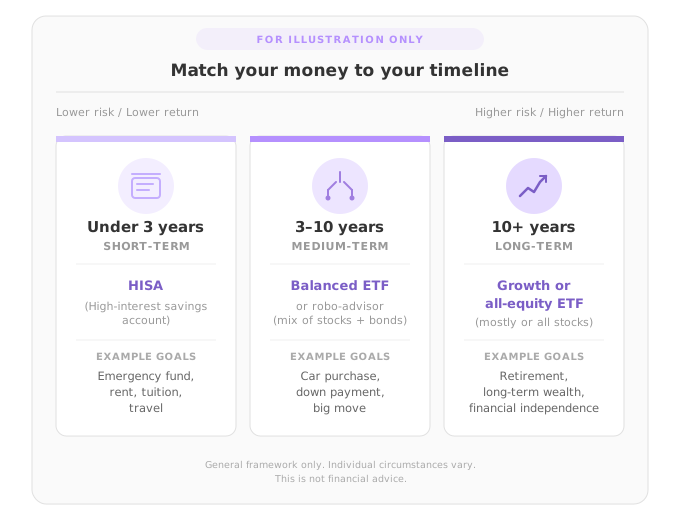
Money has different jobs depending on when you need it. A general framework:
Under 3 years (short-term). Emergency fund, rent, tuition, a trip. This money needs to be there when you reach for it, so protecting it matters more than growing it. A HISA is built for this. Capital preservation is the priority.
3–10 years (medium-term). A car, a down payment, a move to a new city. You have enough runway to handle some ups and downs, but you’d still feel the pain of a big drop right before you need the money. A balanced mix of stocks and bonds (through a robo-advisor or a balanced all-in-one ETF) can work here.
10+ years (long-term). Retirement. Wealth building. Money you won’t touch for a decade or more. This is where a higher allocation to stocks makes sense. RBC Global Asset Management data shows the Canadian stock market has delivered positive returns in about 72% of rolling one-year periods since 1980. Over any rolling 10-year period since 1980, it hasn’t posted a single negative return. Time smooths out volatility.
You might use all three options at once. Emergency fund in a HISA, medium-term savings in a balanced portfolio, long-term money in an all-equity ETF. Different money, different timelines, different containers.
The all-in-one ETF
If you’re going the self-directed route for medium or long-term money, all-in-one ETFs (also called asset allocation ETFs) are worth understanding.
An all-in-one ETF holds a complete diversified portfolio inside a single fund: Canadian stocks, U.S. stocks, international stocks, and bonds. Vanguard’s versions hold over 13,000 stocks and 19,000 bonds across the globe. You buy one fund and get exposure to all of it. The fund provider handles the diversification and rebalances automatically when the mix drifts from its target.
Vanguard Canada pioneered these in 2018, and BlackRock iShares and BMO followed. All three major providers cut their management fees in late 2025, and the all-in cost for these products now sits in the 0.19%–0.24% range. On a $10,000 investment, that’s about $19–$24 per year.
They come in different risk levels based on the stock-to-bond ratio:
- Conservative (~20% stocks, ~80% bonds): lowest volatility, designed for shorter timelines
- Balanced (~60% stocks, ~40% bonds): middle ground between growth and stability
- Growth (~80% stocks, ~20% bonds): higher expected returns, more short-term swings
- All-equity (~100% stocks): highest expected long-term returns, highest short-term volatility
The right mix depends on your timeline and your personal comfort with watching your balance go down temporarily. An all-equity fund could drop 20%–30% in a bad year. If that would keep you up at night or make you sell in a panic, a balanced fund with bonds in the mix might be a better fit even if your timeline is long.
Before you pick individual stocks
Individual stock picking is popular, especially on social media. Before you go that route, a few things are worth knowing.
Concentration risk is real. Owning a single stock means your portfolio rises and falls with one company. A diversified ETF spreads that risk across hundreds or thousands of holdings. Academic research has consistently found that the majority of individual stocks underperform the broad market over their lifetime, and that overall stock market returns are driven by a small fraction of top performers.
Professionals struggle with it too. The SPIVA Canada Mid-Year 2025 Scorecard found that over 71% of active Canadian fund managers underperformed their benchmarks in the first half of 2025. Over 10 years, roughly 95%–98% of Canadian equity funds trailed their benchmarks. These are full-time professionals with research teams and resources that individual investors don’t have.
Behavioral patterns work against you. Academic research by Barber and Odean found that individual investors tend to sell winners too early and hold losers too long, buy stocks that are in the news, and trade too frequently. After costs, the average individual investor in their study earned approximately -3.7% annually relative to the market. The most active traders did even worse at -10.4%.
None of this means you can’t pick stocks. It means going in with your eyes open and understanding the odds. The OSC and CSA both publish free investor education materials if you want to dig deeper.
Fees: why the percentage matters
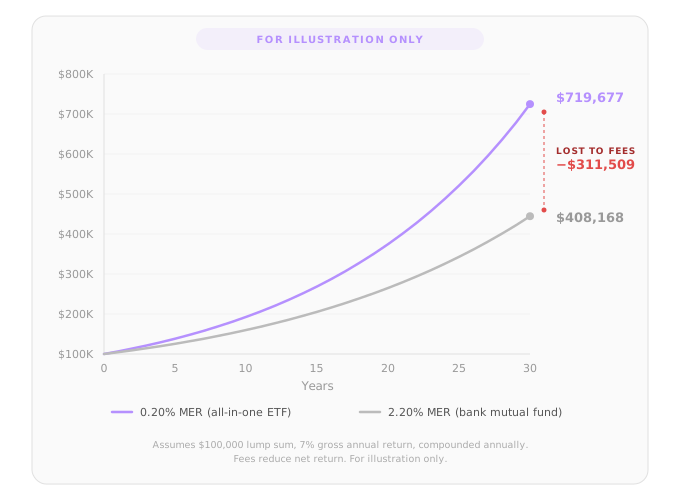
The difference between a 0.20% and a 2.20% annual fee looks small in a single year. Over decades, it’s enormous.
For illustration, on a $100,000 investment earning 7% gross per year over 30 years:
- At 0.20% (all-in-one ETF): grows to ~$761,000
- At 2.20% (typical bank mutual fund): grows to ~$434,000
That’s over $300,000 lost to fees on the same investment. Returns are not guaranteed and this example assumes a fixed annual return, but it shows how fees compound over time.
The OSC fee calculator lets you run your own numbers.
Starting January 2026, new Total Cost Reporting rules require Canadian fund companies to show you the dollar cost of your fees on your annual statement. The first statements under these rules will arrive in early 2027. For the first time, you’ll see exactly how many dollars left your account in fees, not buried in a percentage.
Myth vs. Fact
”You need a lot of money to start investing.”
Most Canadian online brokerages let you open an account with $0 and start investing with as little as $1 through fractional shares. Wealthsimple has no minimum. Questwealth starts at $1,000 for its robo-advisor, and RBC InvestEase starts at $100. The barrier to entry has dropped to the point where the “not enough money” excuse doesn’t hold up anymore.
”A savings account is the safest place for all your money.”
A HISA protects your principal, but inflation eats away at your purchasing power over time. If your HISA earns 2.5% and inflation runs at 3%, your money is losing value in real terms. For short-term money, a HISA is the right call. For long-term money, the “safety” of a savings account comes at the cost of growth you’ll need down the road. The risk of not investing is its own kind of risk.
This Week’s Recommendations
Read: Millionaire Teacher by Andrew Hallam. A Canadian teacher explains how he built wealth on a middle-class salary through index investing. Covers the behavioral side of investing (why your brain works against you) and makes a strong case for keeping things boring. Canadian examples throughout.
Listen: Rational Reminder Podcast by Ben Felix and Cameron Passmore. Two Canadian portfolio managers who dig into academic finance research and translate it into practical investing decisions. Ben Felix’s YouTube channel covers many of the same topics in shorter form if you prefer video.
Next issue: what’s next for you this summer. Whether you’re graduating or coming back in September, we’ll cover the money moves that set up the rest of your year.