Congrats! You finally got the job! You worked your shifts, payday hits, and the number on your deposit is… less than you expected. A lot less. You were supposed to make $2,000 this pay period, but your bank account says $1,500-something. The rest went towards deductions you didn’t ask for and can’t even pronounce.
This issue is about reading that paystub, understanding where the money went, and figuring out how to get some of it back.
What’s on your paystub
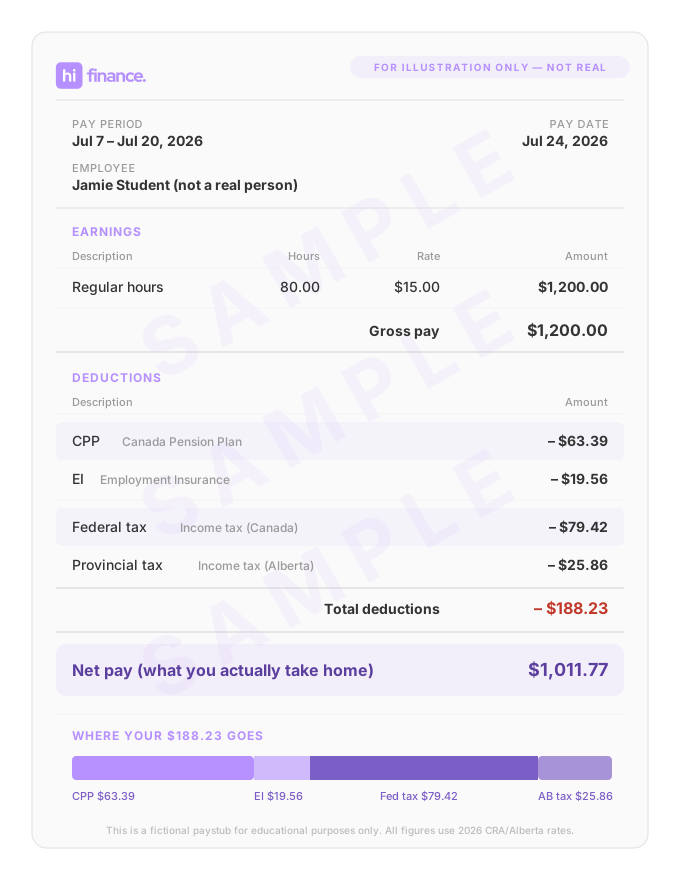
Your employer is legally required to give you a statement at the end of each pay period showing your hours, your wage rate, your total earnings, and a breakdown of deductions with a reason for each one. If you’re getting paid and you haven’t seen a paystub, ask for one. It’s the law.
Here’s what those deduction lines mean:
CPP (Canada Pension Plan). The government’s retirement savings program. You contribute 5.95% of your earnings, and your employer matches it. The first $3,500 you earn in a calendar year (January to December) is exempt, so your employer won’t start deducting CPP until you pass that threshold. If you’re under 18, CPP doesn’t apply to you at all.
EI (Employment Insurance). This one funds the benefits people collect when they lose their jobs. Your rate is $1.63 per $100 of earnings (1.63%), and unlike CPP, there’s no exemption. EI gets deducted from every paycheque.
Federal income tax. Canada taxes income in brackets. The lowest bracket for 2026 is 14% on your first $58,523 of taxable income. But here’s the important part: the federal government gives you a basic personal amount of $16,452. This means that for every dollar you make under this amount, you pay zero federal tax. For most students working a summer job, this is where the overpayment problem starts (more on that below).
Provincial income tax (Alberta). Alberta’s lowest bracket is 8% on the first $60,000. And Alberta has one of the highest basic personal amounts in the country: $22,769. If your total income for the year stays under that number, you owe zero provincial tax. For a student earning $15,000–$20,000 over the summer, this matters a lot.
The form you probably skipped
When you started your job, someone in HR handed you a stack of paperwork. Buried in that stack were two forms: the TD1 (federal) and the TD1AB (Alberta). Most students either left them blank or ticked the default boxes without reading them, but that decision is costing you money on each paycheque.
The TD1 tells your employer how much tax to withhold from your pay. It’s built around your “total claim amount,” which starts at the basic personal amount ($16,452 federal) and goes up from there depending on your situation.
Here’s where students miss out:
Line 5 lets you claim tuition. If you’re paying more than $100 in tuition this calendar year, you can add that amount to your TD1 claim. (If you need a refresher on how tuition credits work, we wrote a full breakdown of the T2202.) A student with $6,000 in tuition bumps their federal claim to $22,452, which means the employer treats the first $22,452 of your annual income as tax-free for federal withholding purposes. That’s less tax deducted per paycheque, and more money in your account right now instead of waiting until you file your return.
Page 2 has a checkbox most students miss. If your total income from ALL jobs this year will be less than your total claim amount on line 13, you can tick that box and your employer won’t deduct any income tax at all. For a student earning under $16,452 for the year, this box means zero federal tax withheld. Zero. You get your full gross pay minus CPP and EI.
If you didn’t fill out a TD1 when you started, your employer is withholding based on the basic personal amount only, and you’re missing any additional credits you qualify for. The good news: you can submit a new TD1 and TD1AB to your employer at any point during the year. Go ask HR for fresh copies, or download them from the CRA website (federal TD1, Alberta TD1AB).
Why you’re overpaying tax
This is the part that frustrates most students once they understand it.
Canadian payroll systems calculate your tax by annualizing each paycheque. They take your gross pay for the period, multiply it by the number of pay periods in a year, and withhold tax as if you’ll earn that amount for all 12 months. The system has no idea that you’re only working May through August.
Here’s what that looks like with an example (for illustration, based on 2026 tax rates):
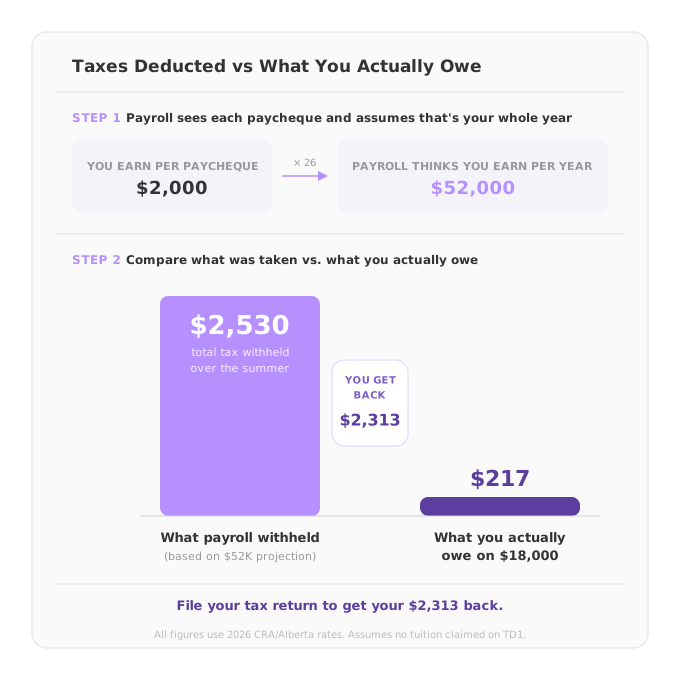
You work a summer job from May to August, earning $2,000 gross per bi-weekly pay period across 9 pay periods. Your total summer income: $18,000.
Your payroll system sees $2,000 per period and multiplies by 26 (bi-weekly periods in a year). It now thinks your annual income is $52,000. At that income level, the system withholds roughly $191 in federal tax and $90 in Alberta tax per paycheque, for a combined $281 per pay period. Over 9 paycheques, that’s about $2,530 in total income tax withheld.
Your actual tax bill on $18,000 of annual income? About $217 federal and $0 Alberta (you’re under the $22,769 provincial basic personal amount). Total: $217.
The difference between what the payroll system took and what you owe is roughly $2,300. That’s money you lent the government, interest-free, because the system assumed you’d earn $52,000 this year. Your numbers will differ depending on your income, deductions, and TD1 claims.
You do get it back when you file your tax return (we covered the full filing process in Issue 7). The CRA compares what was withheld (it’s in Box 22 of your T4 slip) against your actual tax liability, and the difference shows up as your refund. During the 2025 filing season, the CRA issued over 19 million refunds averaging $2,294. A lot of that money belongs to students who could’ve had it months earlier.
If you file electronically, the CRA aims to process your refund within two weeks. Paper returns take closer to eight weeks.
How to stop overpaying
You’ve got two options:
Option 1: Fix your TD1. Go back to your employer and submit updated TD1 and TD1AB forms. Claim your tuition on line 5, and if your total annual income will be under your total claim amount, tick the box on page 2. This is the fastest fix and costs nothing.
Option 2: File a T1213. If your situation is more complex (big RRSP contributions, significant deductions the TD1 doesn’t cover), you can file Form T1213 (Request to Reduce Tax Deductions at Source) with the CRA. They’ll review it and, if approved, send your employer a letter authorizing lower withholdings. This takes 4–6 weeks, so it’s better suited for students who know they’ll be working well into fall.
For most summer-only students, Option 1 covers it.
What about CPP and EI?
CPP and EI aren’t calculated the same way as income tax. They’re based on your actual earnings, not annualized projections, so the over-deduction problem doesn’t hit as hard here.
That said, there are two things worth knowing:
EI has a refund rule for low earners. If your total insurable earnings for the year are $2,000 or less, you get a full refund of all EI premiums when you file your return. You claim it on line 45000. This applies to students who only worked a few shifts or picked up a short-term gig.
You can’t get EI premiums back based on student status alone. If you earned more than $2,000, your EI premiums stay paid regardless of whether you’re going back to school and wouldn’t qualify for EI benefits. The obligation to pay and the eligibility to collect are two separate things.
Myth vs. Fact
”Students don’t pay CPP.”
Wrong. Once you turn 18 and earn more than $3,500 in a calendar year, CPP is mandatory. There’s no student exemption, no part-time exemption, and no seasonal exemption. The only people exempt from CPP are those under 18 or over 70. Your summer job counts, and those contributions go toward your future pension.
”You can’t do anything about tax being taken off your paycheque.”
You can. The TD1 form exists for this exact reason. By claiming tuition credits and ticking the low-income box on page 2, you can reduce or eliminate income tax withholdings at the source. You can also file Form T1213 with the CRA to get authorized reductions. The system defaults to over-withholding because it’s safer for the government, but you’re allowed to correct it.
This Week’s Recommendations
Read: Wealthing Like Rabbits by Robert R. Brown. It teaches compound interest, debt, and housing through pop culture analogies (including a memorable section about The Walking Dead and mortgages). Canadian-written, and it treats you like an adult who also watches TV.
Listen: The Canadian Investor Podcast by Braden Dennis and Simon Belanger. Weekly episodes on Canadian stocks, ETFs, and economic trends. The hosts break down what’s happening in Canadian markets without assuming you have a finance degree.
Next issue: where to put your money. HISAs, ETFs, robo-advisors, and how to match the right account to your timeline. In the meantime, our TFSA guide is a good place to start if you’ve got a refund sitting in your chequing account and no plan for it.